


Outdoor Sports
The same pair of camera glasses is a different tool on a run, a ride and a rock face. What changes is not the hardware but which specification is doing the work.
Ask five outdoor athletes what matters in camera glasses and you will get five spec sheets. The runner will say stabilization. The climber will say nothing bolted to a helmet. The rider will say they cannot hold anything. They are all right, and they are all describing the same device.
The useful question is not "which specification is best" but "which specification decides your sport". This guide works through that, sport by sport.
The two decisions that come before specifications
Every wearable capture choice comes down to where the camera sits and what it is attached to. Those two answers determine almost everything else.
Where it sits decides your field of view. A camera on the chest looks at your arms. A camera on a helmet points wherever your head points. A camera at eye level looks at what you are looking at, which is usually what you would have filmed anyway.
What it is attached to decides your stability and your safety. A rigid attachment to your body is more stable than a strap, and anything added to a helmet is a weight and fit question first.
For every sport below, the constraint that bites is one of those two.
Running: vertical bounce is the whole problem
Running is the hardest common sport to stabilise, because the disturbance is large and rhythmic. Your torso rises and falls several centimetres with every step, which is why vertical oscillation is a tracked running metric at all.
That motion hits the camera at roughly the same cadence as your stride, so it does not average out. It is exactly the frequency band that produces the jittery, unwatchable footage people describe.
This is why the two most popular running setups are both compromises. A chest mount is low, so it catches the arm swing and sits closer to the bouncing mass. A head strap is stable but sits high and front-heavy. Both are trying to solve a problem created by attaching a camera to a moving platform at the wrong point.
A camera in the glasses moves with your head, which is one of the steadiest things you carry while running. Your head is stabilised by your neck and your gaze, so it does not oscillate as much as your torso does. That is a genuine mechanical difference, not a marketing one.
Practical note:: stability is a function of where mass sits and how rigidly it is anchored. It is worth testing any setup on a real run before trusting it, because a treadmill test will not reproduce road texture.

Cycling: resilience and control beat stabilization
Cycling has a much smaller vertical excursion than running. The dominant disturbance is road vibration, which is higher frequency and lower amplitude, and easier for electronic stabilization to handle.
What cycling adds instead is speed, weather and the impossibility of stopping. Three things follow:
- Protection matters more. Rain and road spray are constant, so water resistance is a working specification rather than a detail.
- Control matters more. Reaching for a phone at 30 km/h is not an option, so a way to start and stop capture without moving your hands is worth more than a resolution upgrade.
- Duration matters more. Rides last hours, and the recording limit you hit is power.
Camera glasses address the control problem directly, because the device is already on your face and stays there. A bar-mounted Bluetooth Controller adds start-and-stop from the bars for riders who want a physical button without moving their hands from the hoods.
Hiking and trail running: duration and navigation
Pace is lower, but duration is longer. Two constraints dominate.
The first is power. A hike or a long trail run outlasts most wearable capture setups, so the planning question is not "how good is the footage" but "how do I still be recording at hour four".
The second is that on a trail you are usually also navigating, which means you are already asking your device to do something. Anything that adds a second thing to manage works against you.
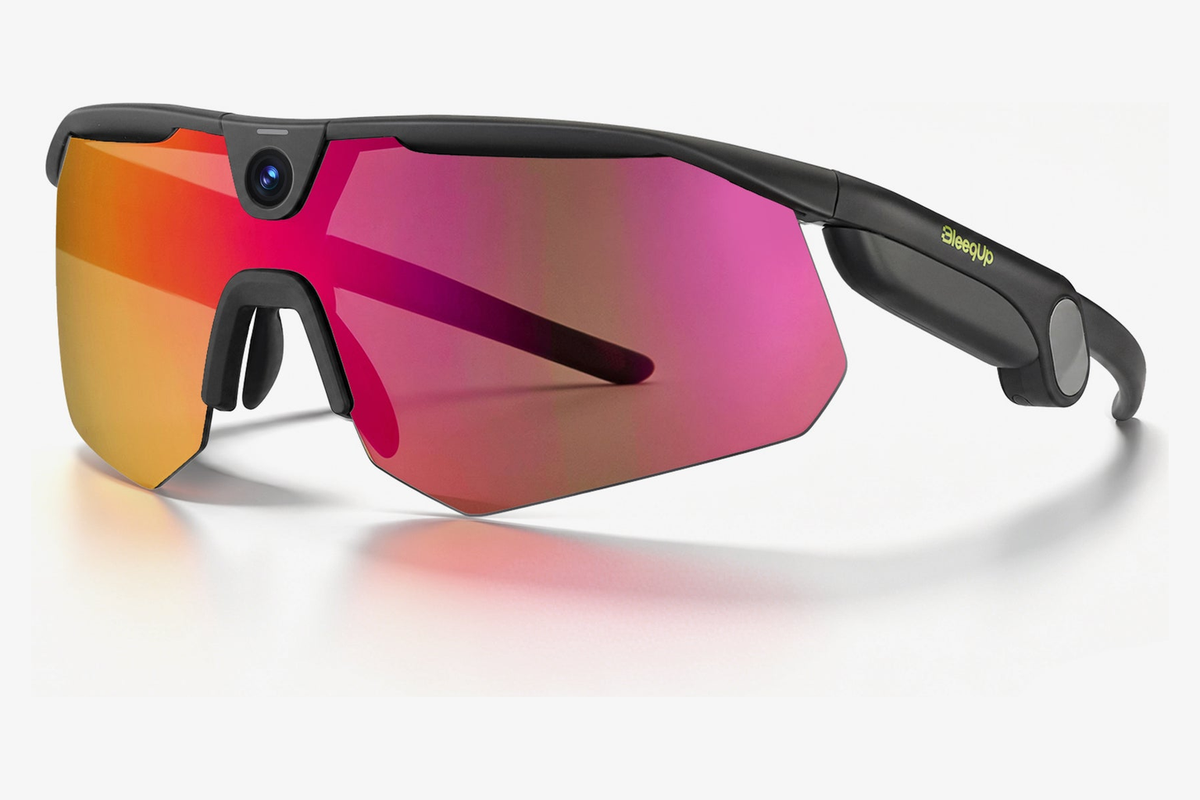
This is the sport where a genuinely useful recording limit is the one that does not exist. BleeqUp Ranger records 1080p30 with no time limit; higher framerate and resolution modes are capped per clip, as listed on the product page. For a long walk, choose the mode that keeps running.

Climbing and mountaineering: your hands are the constraint
Climbing is the clearest case for eyewear, because every alternative competes with the activity itself.
The requirements climbers describe are specific and consistent. They want a wide field of view, because you are close to the rock and need to see holds. They want the camera protected without a housing, because a case blurs the image and muffles sound. They want to hear their partner, because commands are how the system works safely. And they do not want extra weight on a helmet, because a helmet that shifts or dips forward is a safety problem, not an inconvenience.
A camera at eye level answers the field-of-view point directly: it sees what you see, including your hands. An integrated frame answers the protection point, because there is no protruding lens to strike. Open-ear audio answers the commands point without sealing you off from the environment.
Horse riding: nothing to hold, nowhere to mount
On horseback you have at least one hand on the reins at all times, so anything hand-held is out. That is the entire argument, and it is why riders have been early adopters of wearable cameras.
The complication is that the traditional solution, a helmet camera, runs into fit and policy questions that a glasses-mounted camera avoids. Helmets are designed to stay correctly positioned, and adding mass changes that. And many yards and schools restrict or discourage head and chest cameras outright.
Camera glasses sit on the face rather than the helmet, which is the least intrusive place to put a camera on a rider. We cover the practical side in camera glasses for horse riding, and the rule picture in what the recording rules actually say.
What the comparison actually looks like
| Sport | Dominant constraint | Specification that decides it |
|---|---|---|
| Running | Vertical bounce | Camera position and stabilization |
| Cycling | Speed, weather, no stopping | Water resistance, hands-free control |
| Hiking / trail | Duration | Battery, and a recording mode with no clip limit |
| Climbing | Hands and eyes are busy | Field of view, integrated protection, audio |
| Horse riding | Hands occupied, helmet complications | Frame-mounted camera, nothing to mount |
Read down that right-hand column and you will notice the same three properties keep deciding different sports: where the camera sits, how long it runs, and whether your hands are free. Resolution appears nowhere, which surprises people.
The specification that decides most sports: whether you actually use it
There is a final consideration that does not appear in any spec sheet. Footage only exists if you recorded it.
Every mount-based setup has a setup cost, and the more steps it needs, the more often it stays at home. This is not a small effect. The most common failure mode for outdoor recording is not bad image quality, it is a camera that was left in a bag, or a battery that was flat at the trailhead.
The reason eyewear works well across all five sports is not that it is superior at any single specification. It is that the device is already on your face for other reasons, so the cost of starting is close to zero.
If you want the deeper equipment discussion rather than the sport breakdown, best recording glasses covers the buying side, and wearable versus mounted capture covers the format comparison directly.
FAQ
Are camera glasses good for outdoor sports?
They are particularly well suited to sports where your hands are occupied or where mounting a camera is awkward, because the camera sits at eye level and requires no setup. The trade-off is that they move with your head, so footage reflects your head movement rather than the bike or the ground.
What is the best camera position for running footage?
At or near eye level. Chest mounts sit close to the bouncing torso and catch arm swing, while high head straps exaggerate the angle. Keeping the camera closer to the head's natural stabilization reduces the vertical bounce that ruins running footage.
Should I use a camera mount or camera glasses?
Mounts suit situations where you need a specific angle that is not your eyeline, or where you want to swap the camera between activities. Glasses suit hands-busy sports where the eyeline view is the right view and where you do not want to carry or align a bracket.
How long can camera glasses record without stopping?
It depends on the recording mode. BleeqUp Ranger records 1080p30 with no time limit, while 1080p60 and 3K60 are limited to one minute per clip and 3K30 to five minutes, with each clip saving automatically and a new one starting on demand.
Are camera glasses waterproof enough for outdoor use?
Water resistance varies by model and should be checked per product. BleeqUp Ranger is rated IP54, which covers dust and splashing, and that is adequate for rain and sweat in most outdoor use. It is not a rating for submersion.


