


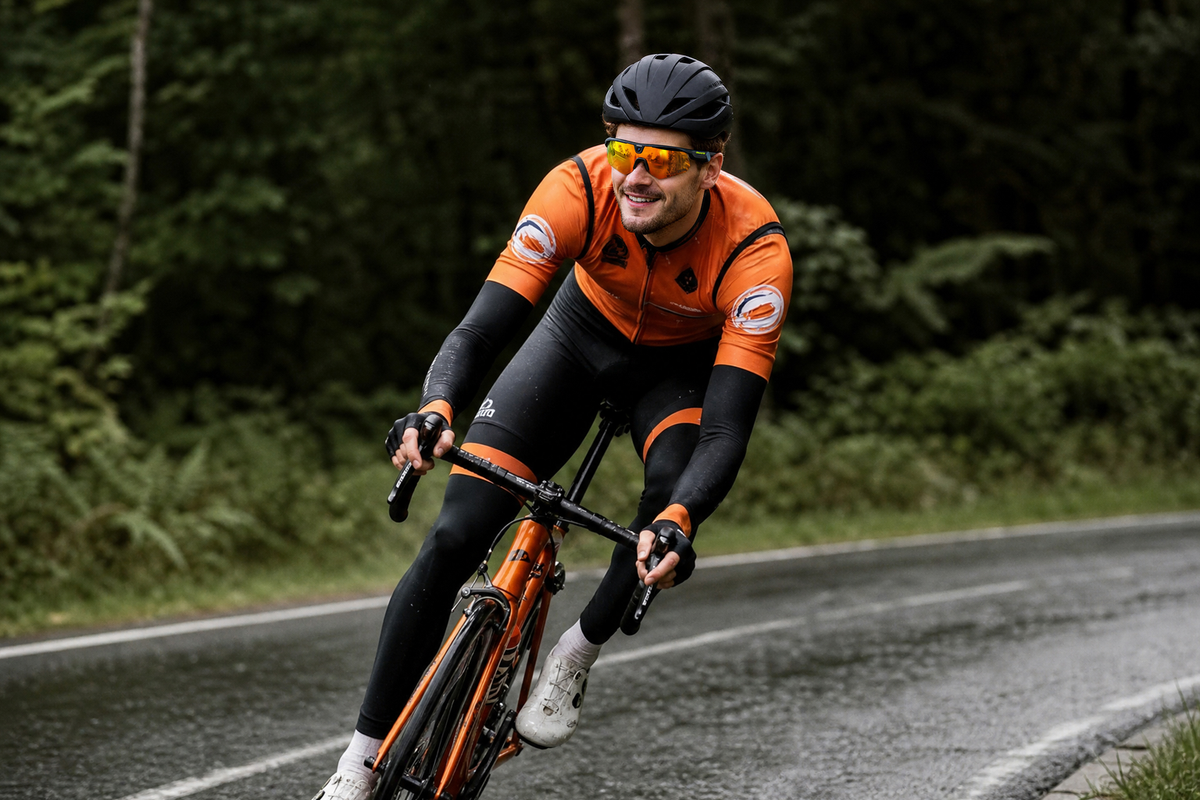
Rain
Rain does not make riding impossible. It changes the coefficient of friction, the distance you can see, and the number of things you can do with cold hands — and most rain advice talks about jackets instead.
Riding in the rain is treated as a kit problem, and it mostly is not. The things that actually change when water is on the road are grip, sight distance, braking distance and how much you can do with your hands. Kit matters because it lets you keep riding, not because it makes the ride safe on its own.
This is the order worth thinking in: surfaces first, then visibility, then the things you wear, and only then the question of whether you are recording.
Rain changes three things before it changes your gear
The road loses grip unevenly. Wet asphalt is not uniformly slippery. It is mostly fine, and then it is not: painted lines, manhole covers, tram rails, wet leaves, and the polished stone that appears in older towns all lose far more grip than the tarmac around them. The danger is the discontinuity, not the wetness.
Braking distances extend, and rim brakes extend more than discs. Water on the rim takes a rotation or two to clear, which is why the first brake application after a wet section feels weak. Discs clear faster and more predictably. Either way, braking earlier than you would in the dry is not caution, it is arithmetic.
Your sight distance falls, and so does everyone else's. Rain on a visor or glasses, spray from a vehicle, and the flat grey light of an overcast day all reduce contrast. Being seen becomes a separate problem from seeing, and both get worse at exactly the time of day when commuters are tired.
What to wear, and what not to bother with
The temptation is to dress for the water. The better instinct is to dress for the effort, because a rain jacket that does not breathe turns a wet ride into a wet and overheating ride, which is worse.
A shell, not insulation. You want a wind and water resistant layer over what you would have worn in dry, cool conditions. Adding warmth under a waterproof layer is how people arrive soaked from the inside.
Legs are less of a problem than they look. Waterproof trousers are genuinely useful for a commute and genuinely miserable for a fast ride, because they trap heat and flap. Water-resistant shorts over bare legs are often the better trade in anything above mild temperatures.
Hands and feet first. Cold, wet hands lose dexterity before they lose feeling, and a rider who cannot operate a shifter or a brake confidently is the real risk. Gloves and overshoes do more for a wet ride than any jacket upgrade.
Fenders are not a fashion decision. A rear fender keeps spray off your back and, on a group ride, off the face of whoever is behind you. That second part is why some clubs require them.
If you want to think about this in terms of what stays on the bike year round rather than what you add for rain, the reasoning in cycling essentials that earn their place applies to the wet months too.
Grip, braking and the surfaces that catch people out
The technique changes are small and unglamorous.
Brake earlier and more gradually. On a wet descent the aim is to have your speed set before the corner, not to brake into it. Traction is shared between turning and stopping, and doing both hard at once is what puts a bike down.
Get off the shiny stuff. Cross painted markings upright where you can, and avoid turning on them. Manhole covers are worse than they look, particularly in the first ten minutes of rain when oil is still floating off the surface.
Let some air out. A slightly lower tyre pressure increases the contact patch and softens the ride on broken wet surfaces. The trade is a little more rolling resistance, which is a fine trade for grip.
Expect the first rain after a dry spell to be the worst. Accumulated oil and rubber dust lift off and float. That window is genuinely more slippery than steady rain.
Seeing and being seen
Lights are not optional in rain. Daytime running lights are the single cheapest improvement to being seen in low contrast conditions, and the effect is larger in spray than in clear air.
Clear or contrast-boosting lenses beat dark ones. A dark sunglass lens in flat rain light reduces contrast exactly when contrast is what you need. A clear or amber-tinted lens raises it. This is the case for a swappable lens over a fixed one.
Visor management is a skill. Water beads on a lens; the fix is a slight head angle at speed, or a gloved thumb at low speed. Anyone who rides in rain regularly develops a preference for how much lens they want in the way.

Recording in the rain: what breaks and what survives
This is where most advice ignores the actual failure modes. Three things go wrong, and only one of them is about water getting inside.
Water on the lens. A droplet sitting in front of the camera is the single most common reason rain footage is unusable — it creates a moving blur that no amount of stabilisation fixes. Framing helps: a lens set back behind a brow line sheds water differently from one on a stalk.
Fogging. Rapid temperature change fogs a lens, and a sealed housing is worse than an open frame because the moisture that got in cannot leave. A housing that is waterproof is not automatically fog-free.
Audio. Rain is loud, and it is loud in a frequency range that competes with speech. A microphone array with wind and handling noise rejection helps here as it does with wind, which is the same physical problem at a lower intensity. The audio side of this is covered in open-ear audio and wind noise.
Cold, not water, is often what ends a recording. Lithium-ion capacity drops as temperature falls, and rain usually arrives with cold. Expect less recording time than the indoor specification, and keep the device out of the coldest airflow if you can.
What the rating means. BleeqUp Ranger is rated IP54, which covers dust and splashing water. That is a ride in the rain, not a river crossing, and it is worth being precise: no IP rating makes a device suitable for submersion, and the honest expectation for any splash-rated device is "worn in weather", not "left in a puddle". The full specification sits on the Ranger AI Sports Camera Glasses page rather than in a review.
If you want to ride further between charges in cold, wet conditions, the Power Plus battery pack is the accessory that changes the runtime rather than the recording quality.
If you are weighing an integrated camera against a separate action camera for weather use, the difference is mainly that an integrated unit has no housing to fog and no external lens to wipe — the trade-offs are set out in camera glasses vs action camera.

After the ride
Five minutes here saves a device.
- Wipe the lens with a clean, non-abrasive cloth while it is wet. Dried-on road spray is harder to remove without scratching a coating.
- Let it dry at room temperature, not on a radiator. Rapid heating drives moisture inward and can stress the seal.
- Charge after it has reached room temperature. Charging a cold cell is the mechanism that shortens battery life permanently.
- Check the seal and the charge port for grit. A dirty contact is the usual cause of a device that will not charge, not a dead battery.
FAQ
Is it safe to cycle in the rain?
It is as safe as the rider's judgement allows. The risk is concentrated in grip changes at painted lines, covers and wet leaves, in longer braking distances, and in reduced visibility for both you and drivers. Slower corner entry, earlier braking, working lights and contrast lenses address most of it.
Do I need a waterproof jacket or just a water-resistant one?
For commuting and steady riding, a breathable waterproof shell is worth it. For hard efforts, a shell you can vent will generally serve you better than a heavier one, because overheating under a sealed layer produces a different kind of soaked.
Can camera glasses record in the rain?
Yes, within their rating. BleeqUp Ranger is IP54 — dust protected and splash resistant — which is intended for being worn in weather rather than being submerged. The practical limits in rain are water beading on the lens, fogging from temperature change, and shorter runtime in the cold.
Why does my footage look worse when it rains?
Three reasons stack up: droplets on the lens create moving blur, low contrast light flattens the image, and rain noise competes with speech on the audio track. Only the last one is fixable in editing.
Should I run lower tyre pressure in the wet?
Slightly lower, yes. A larger contact patch and a softer casing help on wet, broken surfaces. Do not go far below the pressure recommended for your tyre and rim combination — pinch flats and rim damage get more likely fast.


